ABOUT POLAB
Swedish designer and manufacturer of LED street luminaires.
Not a market opportunity. A materials question that nobody thought was worth asking.
Aluminium had long been the standard material for outdoor luminaires. There are sound reasons for this: the material conducts heat efficiently, is well understood by engineers, and is relatively straightforward to process at scale.
But in exposed environments — harbours, coastlines, industrial facilities — we kept seeing the same pattern. Corrosion. Salt ingress. Surface treatments cracking. Gaskets failing to seal. UV radiation attacking the material year after year.
LED technology kept improving. But in many installations, it was still the luminaire housing that failed first.
That raised a question we could not leave alone: why do we build luminaires expected to perform for decades, but make them dependent on a housing that ages faster than the electronics inside?
THE IDEA THAT WOULDN'T WORK
When we began investigating SMC composite as an alternative to aluminium, the response from the industry was almost always the same.
SMC composite conducts heat considerably less effectively than aluminium. In an LED luminaire, thermal management is critical — without adequate cooling, components run too hot, service life drops, and in the worst case the luminaire fails entirely. The material had long been used in infrastructure and marine environments, but for LED luminaires, the combination was considered wrong.
“It won't work.”
It was not an irrational conclusion. It was correct, based on how the industry solved the problem using existing materials and existing design principles.
But it was not a conclusion we accepted.
Anders Sundström developed VALDUR.
Anders worked through a series of designs, geometries and material combinations. The goal was not to prove anyone wrong. The goal was to establish whether the problem could actually be solved through a different design philosophy.
The early prototypes did not perform well enough. That was expected. From each test we learned something about how internal geometry, airflow and material combinations affected temperature. Each iteration provided new insights.
The collaboration with Signify provided access to controlled laboratory testing and component platforms that had undergone thousands of hours of validation. That gave us reference points to measure against — and gradually, results began to move in the right direction.
During the process, an additional opportunity was identified that further strengthened the product: integrating wireless controls directly into the luminaire housing, without a separate unit or additional cabling.
TECHNICAL PARTNER
Signify
Component platforms, laboratory testing, and technical expertise during the design verification of VALDUR.
CONTROLS TECHNOLOGY
LumenRadio — AirGlow
Wireless controls and presence detection integrated directly into the luminaire housing — no separate control unit required.
Manufacturing in Sweden is a deliberate choice: it creates short feedback loops, traceable processes and close control of assembly and quality assurance. VALDUR is not designed to win a lowest-purchase-price comparison, but to compete on material choice, reliability, serviceability and cost over time.
If VALDUR was to have a place in the market, it needed to be better.
Not cheaper.
That is the basis of our position: a materials and system choice for projects where downtime, maintenance and premature replacement cost more than the luminaire itself.
Manufactured in Sweden
The housing is moulded in Ljungby. Final assembly, configuration and quality control take place in Fristad, outside Borås. This keeps development, production and quality assurance close together — and brings project data and field experience directly back into product development.
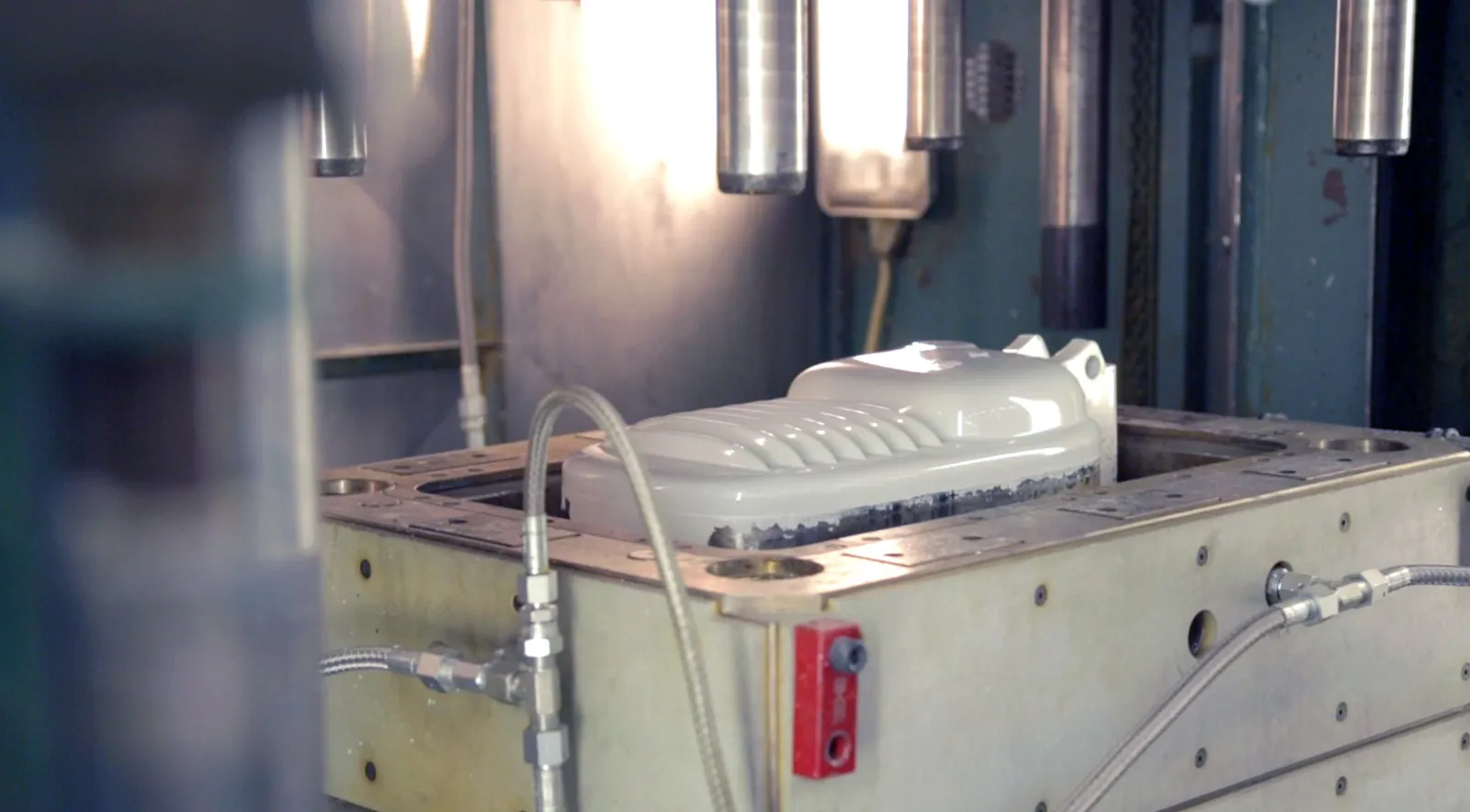
MOULDING — SMC COMPOSITE
Industrial experience in the family.
POLAB's experience extends further back than the VALDUR project itself. The family's industrial roots can be traced to Hans Sundström, who between 1974 and 1999 built and led Sundström Safety — a company manufacturing respiratory protection and personal protective equipment for demanding industrial environments.
Hans's roles as Marketing Director, Deputy Managing Director, Managing Director, and co-owner gave him deep experience of what it takes to bring a quality product to an international market: long product cycles, high performance requirements, and customers operating in environments where luminaire failure carries serious consequences.
That experience provided a foundation for Anders's development of VALDUR and Lennart's work selling the luminaire.
POLAB AND VALDUR
Hans, Anders and Lennart Sundström
Hans founded POLAB and is its Managing Director. Anders developed VALDUR. Lennart leads sales. The company operates from Fristad.
OWNERSHIP
The ownership group also brings experience from entrepreneurship, investment, and business development through Öjvind Norberg and Karl Åberg.
What began as a technical idea is now used in municipal, industrial and coastal environments. The same materials and system logic is relevant in Scandinavia, wider Europe, Africa and other markets — provided the local exposure is within the product’s specified limits and is assessed for the project.
The proof that matters most to us is repeat business: customers return when the luminaire performs as specified in demanding service.
Municipal
road lighting
Industrial
process environments
Coastal
marine environments

We are not trying to build the world's most complex luminaire.
Our aim is to build lighting where material choice, service life and long-term cost of ownership outweigh short-term compromises.