Technology — LED Module
Light begins at the chip.
VALDUR LED modules are specified with requirements for colour tolerance, electrical characteristics and thermal performance. Binning and documented test data contribute to uniform light and provide a basis for projections of LED-module lumen maintenance.
The same light, luminaire after luminaire.
The manufacturing process for LED chips produces natural variation in luminous flux, forward voltage, and colour temperature between individual diodes. For a road with 50 columns to read as uniformly lit — rather than a patchwork of warmer and cooler whites — the chips must be sorted, or “binned”, within close tolerances before assembly.
Colour consistency depends on the selected LED module and order code and is verified per configuration.
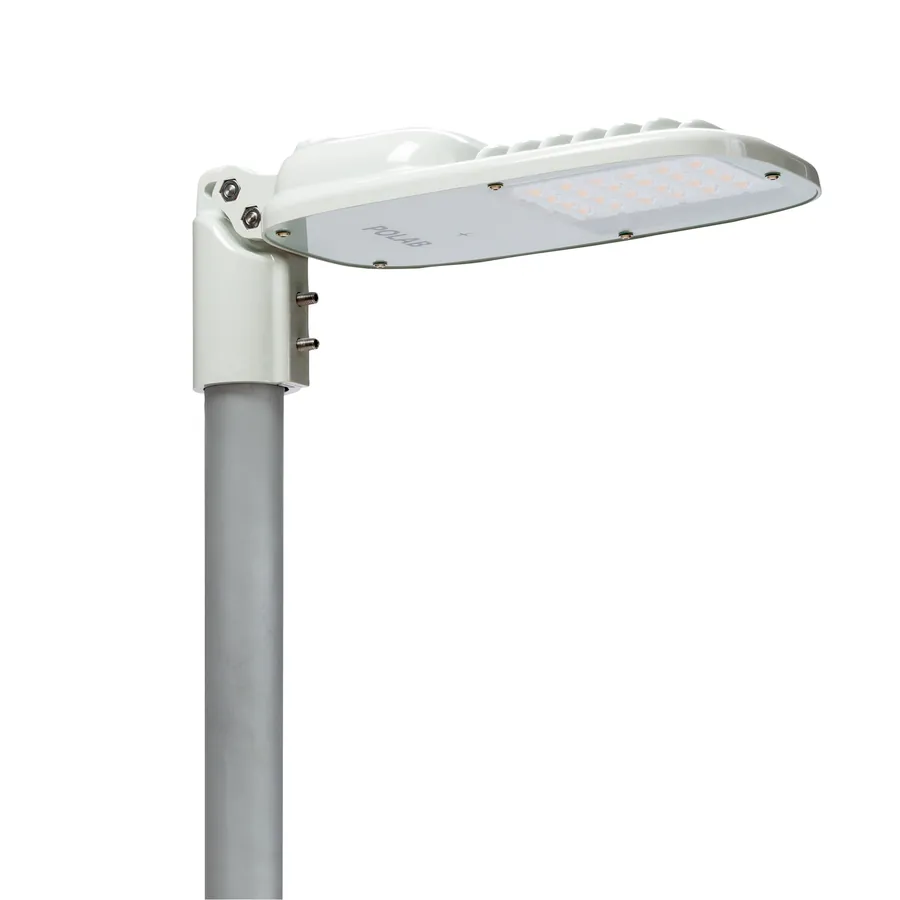
The right light tone for every environment.
The applications below are examples to assess for the project. Colour temperature alone determines neither visibility nor ecological suitability; light levels, distribution, spectrum and operating time also matter.
2200 K
Extra warm white — coastal, urban, and residential environments
2700 K
Warm white — residential streets, parks, and squares
3000 K
Warm white — modern street lighting, car parks, and town centres
4000 K
Neutral white — high-traffic roads, industrial areas, and busy car parks
Amber/Bio
approximately 1900–2900 K — reduced short-wavelength content
5000 K
Daylight — specialist applications
5700 K
Cool white — available to order
SPECTRE-Y
4000 K LED → ~2500 K in LEDiL’s component example; VALDUR is verified per configuration
The Amber range of approximately 1900–2900 K refers to LEDiL’s indicative examples using 2200–5700 K LEDs. VALDUR’s standard Amber references use a 2200 K LED and produce approximately 1900 K output. POLAB confirms other output values and SPECTRE configurations separately. LEDiL Amber data; VALDUR standard product codes.
The Amber/Bio variant (approximately 1900–2900 K) has reduced short-wavelength content compared with whiter alternatives and can be one of several measures used to limit light pollution. Ecological effects cannot be determined from CCT or blue-light proportion alone; the species concerned, spectrum, illuminance, direction, operating time and season must be assessed for the site. Installation in or near Natura 2000 must be assessed against the site’s conservation objectives.
What does L90/B10 mean?
LED modules can both lose luminous flux gradually and cease operating abruptly; LxBy describes only gradual luminous-flux depreciation in a defined population of still-operating LED modules. L90 is the threshold of 90 % of initial luminous flux. B10 indicates that no more than 10 % of the still-operating modules may be below L90 at the stated operating time; abrupt failures are not included in B10.
The value L90/B10 at >100,000 hours refers to the projected lumen maintenance of VALDUR’s LED modules and is not a guarantee of the complete luminaire’s service life. 100,000 hours corresponds to just over 27 years only as a time conversion assuming 10 hours of operation per day.
LM-80 and TM-21.
ANSI/IES LM-80-21 is a measurement method for the maintenance of luminous flux, colour and other light-output characteristics of LED packages, arrays and modules under controlled conditions. ANSI/IES TM-21-21 uses averaged LM-80 data to project luminous-flux maintenance. The reportable projection is governed by the method’s applicable reporting limit and can never exceed six times the applicable LM-80 test duration; TM-21 does not by itself establish a B10 value.
Values are meaningfully comparable only when test temperature, drive current, test duration, projection period and LED configuration, among other factors, are assessed on the same basis.
LED module in VALDUR — summary
| Parameter | Value |
|---|---|
| Projected LED-module lumen maintenance | >100,000 h (L90/B10) |
| System efficacy, complete luminaire | 150.2–164.3 lm/W for white standard configurations at 3000/4000 K |
| Colour temperature (CCT) | 2200 / 2700 / 3000 / 4000 / 5000 / 5700 K · Amber/Bio approximately 1900–2900 K · SPECTRE-Y ~2500 K in LEDiL’s example with a 4000 K LED |
| Colour rendering (CRI) | Standard white LED: Ra ≥ 70. ColorRevive: Ra ≥ 80. Filtered Amber and SPECTRE-Y are reported separately and are not covered by these general Ra values. |
| Colour consistency | Depends on the selected LED module and order code and is verified per configuration. |
| Measurement and projection methods | ANSI/IES LM-80-21 / ANSI/IES TM-21-21 |
Relevant standards for LED modules
IEC 62717
Performance requirements for LED modules in general lighting.
ANSI/IES LM-80
Measurement method for luminous flux and colour maintenance of LED packages, arrays and modules.
ANSI/IES TM-21
Projection method for long-term lumen maintenance based on LM-80 data.
EN 62471
Photobiological safety of lamps and lamp systems — exposure limits, reference measurements and classification of optical-radiation hazards, including blue-light hazard.
About LED modules
What does L90/B10 mean?
L90 is the threshold of 90 % of initial luminous flux. In LxBy notation, B10 indicates that no more than 10 % of a defined population of still-operating LED modules may be below L90 at the stated operating time; abrupt failures are excluded. TM-21 projects luminous-flux maintenance from averaged LM-80 data but does not establish B10. The declaration concerns LED modules, not the service life of the complete luminaire.
Why is there an Amber/Bio variant with reduced blue-light content?
The Amber/Bio variant (approximately 1900–2900 K) has reduced short-wavelength content compared with whiter alternatives and can be one of several measures used to limit light pollution. Ecological effects cannot be determined from CCT or blue-light proportion alone; the species concerned, spectrum, illuminance, direction, operating time and season must be assessed for the site. Installation in or near Natura 2000 must be assessed against the site’s conservation objectives. The range is based on LEDiL’s indicative component examples; VALDUR’s standard Amber references use a 2200 K LED and produce approximately 1900 K output.
What is the difference between Ra70 and Ra80?
Ra is a general colour-rendering index comparing test colours under the source with a defined reference illuminant, not always daylight. Ra80 indicates higher average colour rendering by this method than Ra70, but does not alone describe visibility, facial recognition or safety. Select the requirement for the project and verify Ra for the complete optical configuration. CIE 013.3.
How is consistent colour temperature ensured between luminaires in the same installation?
Colour consistency depends on the selected LED module and order code and is verified per configuration.
Is blue-light content a concern for outdoor lighting?
EN 62471 specifies exposure limits, reference measurements and a classification scheme for photobiological hazards from lamps and lamp systems, including blue-light hazard. Any VALDUR-specific risk-group statement must be supported by documentation identifying the evaluated light source or luminaire configuration and the relevant measurement conditions. Ecological effects in natural environments require a separate site-specific assessment and cannot be determined from EN 62471 classification or CCT alone.
Sources and technical documentation
- IES — ANSI/IES LM-80-21
- IES — ANSI/IES TM-21-21
- IES — Position on LED Product Lifetime Prediction
- LightingEurope — Evaluating performance of LED based luminaires (2025)
- CIE 013.3-1995 — Colour rendering properties of light sources
- CIE — Position Statement on CRI and Colour Quality Metrics
- IEC 62717 — LED modules: performance requirements
- IEC 62471 — Photobiological safety
- LEDiL — Amber lenses: component examples
Related technologies
DOCUMENTS & PRODUCT
Request the complete technical documentation.
Data sheets, IES files, lighting calculation support, and installation drawings — in a single package.