Technology — Controls
Ready for smart networks.
A luminaire that simply lights is fully functional — but a luminaire that can be controlled, monitored, and connected to sensors is an infrastructure investment that can evolve with the city's needs, even years after installation.
Choose your level of control.
1–10 V
Analogue dimming via a control signal from an external device. 1–10 V applies to the specified Xitanium LP S1 variants.
DALI-2
Digital bus protocol with individual addressing, group control, and status feedback per luminaire.
Zhaga Book 18
Standardised mechanical and electrical interface for sensor and communication nodes. Optional on the top (ZH1), the bottom (ZH2) or both (ZH3).
Fixed control level
A configuration without external dimming control can be specified for the project. CLO is included as standard in every VALDUR luminaire.
DALI-2
Every luminaire, individually addressable.
DALI-2 (Digital Addressable Lighting Interface) is an internationally standardised bus protocol in which each luminaire receives its own digital address. This makes it possible to control individual luminaires, group them freely by geography or function, and apply individual dimming schedules — all from a central control unit.
Unlike analogue 1–10 V control, DALI-2 provides two-way communication and individual addressing. Support for luminaire/asset data via Part 251, energy reporting via Part 252, and operating time and diagnostics via Part 253 is configuration-dependent. Full D4i certification of an LED driver additionally requires Part 207 and Part 250 for integrated DALI bus power, together with a current entry in the DALI Alliance product database. DALI Alliance — D4i
Signal Path
Luminaire (VALDUR)
Individual DALI-2 address
DALI-2 bus
Control & status feedback
Control unit / Gateway
Municipal operations & monitoring system
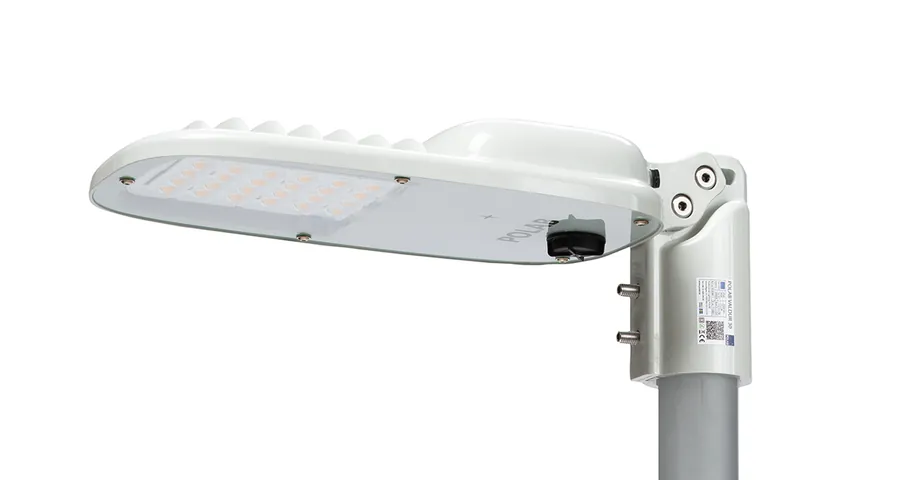
Zhaga Book 18
A standardised socket for tomorrow's sensors.
Zhaga Book 18 defines a standardised mechanical and electrical interface for sensor and communication nodes, not for driver mounting. On VALDUR, the socket is optional and can be ordered on the top (ZH1), the bottom (ZH2) or both (ZH3), depending on the ordered configuration. Zhaga Book 18
A socket prepares the luminaire for compatible nodes. Verify functions, power budget, mounting, certification and management-platform connection for the ordered combination.
Open interfaces, established partners.
VALDUR can integrate with DALI-2 and wireless systems in a suitable configuration. The SMC housing permits internal radio integration, but antenna placement, range and operation must be verified for the complete construction and installation environment.
Radar Control
Comlight
Eagle Eye Zhaga uses Doppler radar in the 24 GHz band for motion detection and a separate radio for node coordination. Specify gateway and network capacity for the selected system. Comlight
Wireless Mesh
LumenRadio AirGlow
Embeddable wireless mesh solution (MiraMesh). Commissioned via mobile app; the app must be connected to the Internet during system setup and commissioning of each AirGlow. The AirGlow device itself does not require an Internet connection. LumenRadio states a line-of-sight range of up to 1,500 m and recommends a maximum distance of 150 m between any two AirGlow units in installations. Actual range must be verified for the specific installation. Scene and group control. LumenRadio — AirGlow
CASAMBI MESH
Casambi
Casambi’s own mesh network for lighting control, using Bluetooth Low Energy for app communication. Commissioning, grouping and schedules use the Casambi app. A Bluetooth Mesh label on another platform does not establish Casambi compatibility. Casambi
DALI-2 / Gateway
Tridonic
DALI-2 and sensor solutions, including FSensor SSI 31 2xPIR with two PIR sensors. Gateway and radio platform depend on the selected product; the cited bDW variant uses basicDIM Wireless. Tridonic
Central Management
Capelon
Central management systems with gateway for monitoring and controlling entire luminaire fleets from a single interface. Capelon — GreenStreet
Specific nodes for the Zhaga socket.
A selection of sensors currently available for mounting in the Zhaga Book 18 socket or directly on the column.
Radar Sensor
Eagle Eye / Eagle Eye 3.0
Radar motion detection. Comlight’s Eagle Eye Zhaga datasheet requires a downward-facing Book 18 socket on the luminaire underside. Check model, detection area and installation instructions; pole-mounted variants are separate configurations. Comlight Eagle Eye Zhaga
PIR Sensor
TE Connectivity
Passive infrared motion sensor (PIR) for occupancy-triggered dimming and switching. TE Connectivity — LUMAWISE Motion
PIR Sensor · Bluetooth Mesh
Hytronik HIR15/BLE
PIR motion sensor with built-in daylight sensing, DALI-2 dimming, and Zhaga Book 18 compatibility. Commissioned and controlled wirelessly via Bluetooth Mesh in the Koolmesh app. Hytronik HIR15/BLE
Controls in VALDUR — summary
| Parameter | Value |
|---|---|
| Driver interface | 1–10 V (LP S1) or DALI-2 (FP/SR/CR); the specified SR/CR configurations are also D4i-certified. A configuration without external dimming can be specified. |
| DALI-2 addressing | Individual, per luminaire |
| DALI-2 feedback | Status via DALI-2; configuration-dependent support for luminaire/asset data (Part 251), energy reporting (Part 252), and operating time and diagnostics (Part 253) |
| Sensor interface | Zhaga Book 18, optional for sensor and communication nodes; top (ZH1), bottom (ZH2) or both (ZH3), depending on the ordered configuration |
| Retrofit sensor node | Possible only when the luminaire was ordered with a compatible Zhaga Book 18 socket, the correct wiring, and a suitable D4i configuration. The node, communication system, and compatibility must be verified separately. |
Relevant standards for control systems
IEC 62386
The DALI-2 standard series for digital lighting control.
Zhaga Book 18
Mechanical and electrical interface for nodes on street luminaires.
EN 13201-2
EN 13201-2 specifies performance requirements to consider when designing dimming schedules. Also check the road authority’s national and project requirements; current VGU may be relevant to Swedish projects. EN 13201-2
IEC 61547
EMC immunity requirements — also relevant for digital control interfaces.
About controls
Can VALDUR be controlled alongside existing DALI installations?
VALDUR can be specified with a DALI-2 driver. Integration requires compatible drivers, control systems, wiring and programming. Confirm the ordered configuration with Polab; an LP 1–10 V driver cannot gain DALI-2 through programming alone.
What can be connected to the Zhaga Book 18 socket?
Compatible sensing and communication nodes within the correct power budget. A Book 18 socket is not a general connection for every camera, gateway or environmental sensor. Verify the exact node, mounting, DALI functions and management platform.
Does the Zhaga node require a separate power supply?
A compatible node can receive power from the luminaire when it is ordered with the correct driver, socket and wiring. The node's power requirements and interface must be verified for the specific configuration.
Is it possible to upgrade from 1–10 V to DALI-2 after installation?
An LP S1 configuration cannot be upgraded to DALI-2 through reprogramming alone. The existing driver must be replaced with a compatible DALI-2 driver. Wiring, the control system, programming, and overall system compatibility must also be verified for the project.
Related technologies
DOCUMENTS & PRODUCT
Request the complete technical documentation.
Data sheets, IES files, lighting calculation support, and installation drawings — in a single package.
Sources
- DALI Alliance — D4i overview
- Zhaga — Smart interface between outdoor luminaires and sensing / communication modules (Book 18)
- LumenRadio — AirGlow, product information and FAQ
- Casambi — Casambi Mesh with Bluetooth Low Energy
- Comlight — Eagle Eye Zhaga Datasheet 8421
- Hytronik — HIR15/BLE, datasheet 27 April 2026
- Tridonic — FSensor SSI 31 2xPIR 8DP DG bDW installation instructions
- TE Connectivity — LUMAWISE Motion, programmable sensor
- Capelon — GreenStreet — Solution overview
- SIS — SS-EN 13201-2:2016 / EN 13201-2:2015, Road lighting — Performance requirements