TECHNOLOGY — MATERIALS
The material that determines the luminaire’s service life.
A street luminaire is exposed to UV, moisture, salt, temperature cycling and mechanical stress for decades. That is why the housing is a technical part of the system’s service life — not merely a styling detail. Here we explain how material choice affects operational reliability, maintenance requirements and system integration.
A material family with established industrial applications.
SMC is a compression-moulding compound with a thermoset matrix, fibres, fillers and additives. Its formulation is selected for the component’s electrical, mechanical and thermal requirements. Properties therefore need to be verified for a specific material grade and production process. (European Alliance for SMC BMC)
SMC is used in electrical enclosures and industrial components. VALDUR combines a moulded glass-fibre SMC housing with separate electronic, optical and thermal functions. Experience from other applications does not replace validation of the complete luminaire.
What SMC actually consists of.
STRUCTURAL REINFORCEMENT
Glass fibre
Provides stiffness, strength and dimensional stability — what elevates SMC far above unreinforced plastics.
MATRIX
Thermoset resin (polyester)
The cured, cross-linked network that binds the fibres together and cannot be remelted.
FILLERS
Mineral fillers
Adjust dimensional stability, shrinkage, stiffness and fire properties.
ADDITIVES
Process and protective additives
UV stabilisers, low-shrink agents and thickeners that control how the sheet matures before moulding.
Material data varies between SMC formulations and suppliers. Values on this page refer to typical industrial/electrical SMC grades — not a single universal SMC value.
Galvanic corrosion begins at the interface.
Aluminium housings exposed to road salt, sea air or industrial pollutants corrode over time — the process is further accelerated by contact between dissimilar metals (galvanic corrosion), for example where screws, brackets or contacts made of another metal meet the housing.
VALDUR’s electrically insulating glass-fibre SMC housing does not act as an electrode in a galvanic couple or undergo metallic corrosion. This applies to this housing material; conductive composites and the luminaire’s metal components require separate assessment. (TWI)
POLAB specifies 316 stainless steel for the stated metallic fixings. Even 316 needs assessment for chloride exposure, crevices, surface finish and material contacts; the grade alone does not guarantee resistance to every corrosion mechanism.
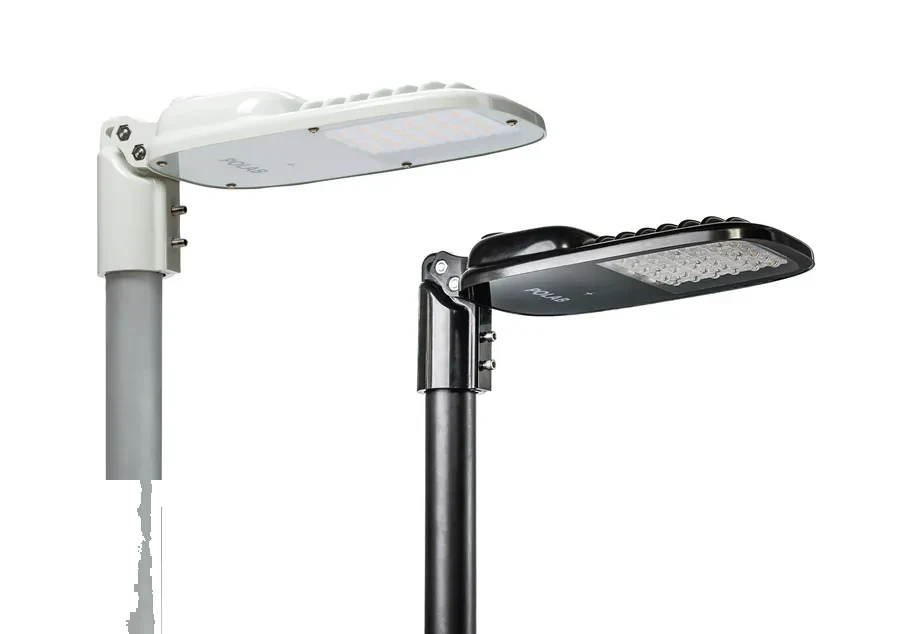
At Smögen Pier in Sotenäs, VALDUR luminaires have been in continuous coastal service since 2024 — now the largest single VALDUR installation to date and the primary field reference for long-term performance in a high-salinity marine environment. For a deeper look at the electrochemistry behind corrosion in luminaire housings, see Why Luminaire Housings Corrode in the knowledge base. Field experience covers the documented time since installation; it does not by itself establish several decades of service life.
Protected against weather, water and mechanical impact.
IP66
Dust-tight and protected against powerful water jets
IP66 describes protection against dust and powerful water jets under defined test conditions in IEC 60529. It is not a guarantee of a particular service life or proof of vapour-tightness. The evidence needs to identify the specimen, assembly, conditioning and applicable luminaire requirements under IEC 60598-1. (IEC 60529)
IK08
Mechanically impact-resistant housing
IK08 specifies 5 J impact energy for the tested complete luminaire. It is not a generic material property or protection against every in-service impact. Follow the configuration and assessment criteria in the test report. (IEC 62262)
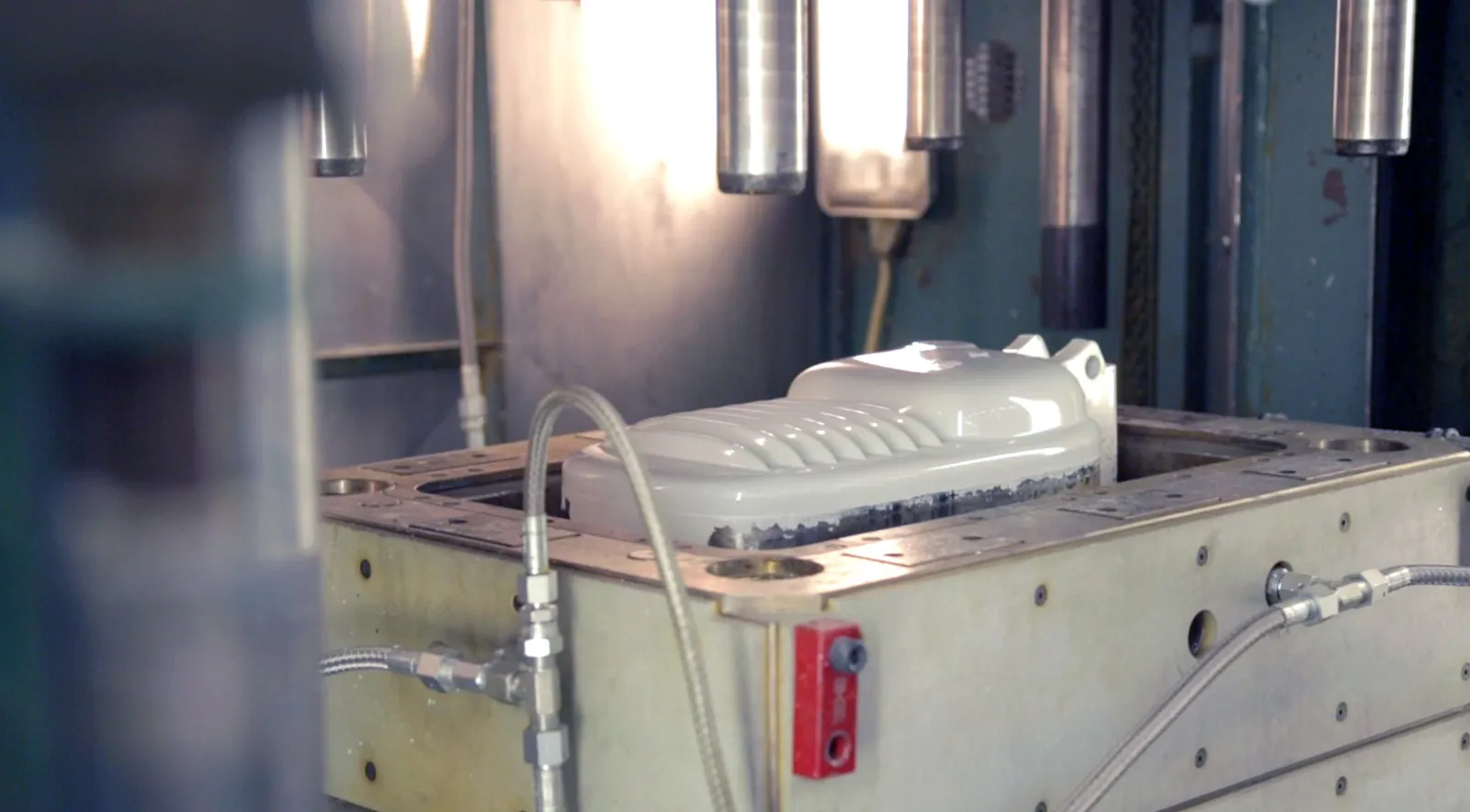
Compression moulding with 400 tonnes of clamping force.
SMC composite is manufactured by compression moulding under heat and controlled pressure rather than being die-cast like aluminium. The processes have different material and defect profiles. Dimensional accuracy, porosity, surface quality and other properties depend on the material formulation, tooling, process parameters and quality assurance. Product-specific test data is needed for direct comparisons of weight, strength and service life.
400 t
Clamping force during moulding
~33 %
Lower density than aluminium
1.8 kg
Housing body weight
Test data
Required for the intended exposure
THE PROCESS IN THREE STEPS
From sheet to finished housing.
STEP 1
Sheet layering
Resin paste is applied to a carrier film, chopped glass fibre is dispersed on top, and a second film layer forms a sandwich that is rolled so the fibres are wetted out and the material homogenised.
STEP 2
Maturation
Over several days viscosity increases as the thickening system reacts — an often overlooked but critical step to make the sheet mouldable without the fibres washing away in the tool.
STEP 3
Moulding
The matured sheet is cut, placed in a heated steel mould and cured under pressure. Temperature, pressure and time must suit the material, geometry and quality requirements.
The VALDUR housing is moulded at 150 °C with 400 tonnes of clamping force. Clamping force is a force specification; pressure also depends on the loaded mould area.
THE THERMAL TRADE-OFF
SMC insulates against heat. That is why we solve the LED module’s own heat differently.
Glass-fibre SMC generally conducts heat much less readily than aluminium. Conductivity depends on the specific formulation or alloy, so a universal SMC value is misleading. Heat from the LED module needs a designed thermal path validated in the complete luminaire.
VALDUR therefore uses a hybrid approach rather than expecting a single material to do everything: SMC provides structure, insulation and weather protection, while dedicated internal aluminium heat sinks conduct heat away from the LED module. This patent-pending thermal-management technology was developed by POLAB. The specified ambient operating-temperature range is −40°C to +40°C. Actual component temperatures depend on the complete luminaire configuration and must be verified under relevant operating and exposure conditions.
THE PATH HEAT TAKES
LED module
Generates heat during operation
Internal aluminium heat sinks
Conducts heat away from the LED module
SMC housing (exterior)
Limits heat conduction through the housing wall
Electrically insulating and radio-transparent — with lifecycle trade-offs.
ELECTRICAL SAFETY
Naturally electrically insulating
SMC composite is electrically insulating. Protection against accessible parts becoming live is determined by the luminaire’s complete electrical and mechanical construction, not by the housing material alone.
RADIO TRANSPARENCY
Wireless signal without apertures in the housing
Electrically insulating, glass-fibre SMC can allow an antenna inside the housing. Signal attenuation depends on formulation, fillers, wall thickness, frequency and antenna placement. Metal can shield radio signals, so performance must be verified in the complete luminaire.
LIFECYCLE PERSPECTIVE
Comparable data are required
Aluminium and SMC have different characteristics in manufacturing, use, maintenance and recycling. Which alternative has the lower climate impact cannot be determined from material type alone; it requires comparable, product-specific lifecycle data using the same functional unit and system boundaries.
UV, moisture and temperature over time.
Like all polymers, SMC is affected by UV, moisture and temperature over time — it would be dishonest to claim otherwise. Research on glass fibre reinforced composites shows that moisture and UV can affect strength and stiffness, through plasticisation and surface oxidation.
UV exposure can cause dulling and surface wear over time. Effects on the surface and the material’s load-bearing properties depend on the formulation of the SMC grade, exposure and duration.
This needs to be substantiated by test data for the specific material grade. Experience from other SMC and GRP enclosures does not replace product-specific verification of the VALDUR housing.
WHAT ACTUALLY HAPPENS OVER TIME
Surface: UV exposure can cause dulling and surface wear over time.
Load-bearing properties: the effects depend on material formulation, exposure and duration and must be substantiated by test data for the specific SMC grade.
Function: electrical insulation, ingress protection and mechanical strength must be assessed based on the product specification, test data and actual exposure.
How SMC compares to other housing materials
Material properties in outdoor service — the factors affecting service life, maintenance requirements and system integration.
| Property | SMC Composite | Aluminium | Steel |
|---|---|---|---|
| When the surface is scratched | No metallic corrosion of the housing material Scratches and mechanical damage still need assessment. |
Dependent on surface treatment integrity Painted: surface layer is decisive. Anodised: integrated oxide layer, but sensitive at edges and damage zones. |
Surface protection can be breached Corrosion protection resides in the surface layer. |
| Galvanic corrosion | No galvanic corrosion in the material Non-metallic housing. |
Risk at contact with dissimilar metals Accelerated by chloride and moisture. |
Corrosion risk without protective system Requires active surface treatment. |
| Surface treatment for corrosion protection | No paint system required Colour-through material. No paint, no powder coat, no anodising required. |
Painting or anodising Periodic renewal. |
Painting or galvanising Periodic renewal. |
| Wireless communication | An internal antenna can be possible Attenuation depends on material and design. |
Metal can shield the signal An external antenna or radio window can be used. |
Metal can shield the signal An external antenna or radio window can be used. |
| Electrical conductivity | Electrically insulating material Protection class is determined by the complete luminaire. |
Electrically conductive material Protection class is determined by the complete luminaire. |
Electrically conductive material Protection class is determined by the complete luminaire. |
| UV resistance | UV performance requires verification Depends on SMC grade, exposure and duration. |
Depends on surface treatment Paint systems and anodising have varying resistance. |
Depends on surface treatment UV resistance of the paint system is decisive. |
| Weight (density) | ~1.8 g/cm³ Lightweight. |
~2.7 g/cm³ (+50 %) Lower density than steel. |
~7.8 g/cm³ (+330 %) Heavy. |
| Thermal conductivity | ~0.7 W/mK (thermal insulator) Separate cooling solution for LED module. See note below. |
130–160 W/mK Suitable as integrated heat sink. |
~50 W/mK Good thermal conductivity. |
| Recyclability | Mechanical recycling possible Thermoset cannot be remelted. |
Remelting possible Established recycling process. |
Remelting possible Established recycling process. |
| Maintenance in coastal environments | No paint system to renew Corrosion protection is a property of the material, not the surface treatment. |
Periodic upkeep Surface layers age faster in saline environments. |
Requires active maintenance Corrosion escalates without maintenance. |
On thermal conductivity and LED cooling
Low conductivity limits heat transfer through the housing wall in both directions. It does not guarantee lower electronics temperatures under sunlight. VALDUR’s internal aluminium heatsinks form part of a separate thermal path from the LED module; the complete design must be validated under the specified operating conditions.
The table’s approximate density and conductivity figures are comparison values, not verified VALDUR material data. Check them against the datasheet for the actual material grade. Density is distinct from the weight of the complete luminaire.
Composite materials in demanding infrastructure.
The examples below show how fibre-reinforced polymers (GRP, FRP, SMC, BMC) are used in environments where corrosion, electrical insulation, low weight or radio transparency place high demands on the material. Common to all applications is that the material family was chosen based on performance, not convention. See note below for material-specific information.
TECHNICAL ENCLOSURES
Electricity networks and secondary substations
GRP-encased secondary substations and cable housings for electricity networks are used in long-lived outdoor installations by European network operators. The material is chosen where long-term operational reliability is prioritised.
RAIL
Third-rail insulators
SMC insulators for third rails are used in metro and light rail systems internationally, with specified requirements for electrical insulation, impact resistance and UV stability.
COMMUNICATIONS
Radomes for 5G and satellite
A radome must combine mechanical protection with sufficiently low radio attenuation at the intended frequencies. Material, thickness and design need validation with the antenna; “RF transparent” does not mean lossless.
MARINE ENVIRONMENTS
Marine composite components
Onboard composite components require product- and application-specific assessment of fire, mechanical and environmental requirements. Any classification approval has a defined scope; it cannot be transferred to other products in the material family.
INDUSTRIAL COMPONENTS
Automotive and domestic appliances
SMC and BMC are used in bonnets, electrical boxes and white goods in series production — processes requiring precise tolerances and repeatable quality.
RAIL INFRASTRUCTURE
Eurobalise housing (Alstom)
Clayens reports producing 15,000–25,000 Eurobalise housings annually for Alstom since 2014, using the described bio-based material since 2019. This is an example of another composite application, not testing of VALDUR. (Clayens)
These examples involve different composite formulations and processes. The names overlap: FRP covers fibre-reinforced polymers, GRP specifies glass-fibre reinforcement, and SMC/BMC describe moulding compounds.
The material’s service life is not the electronics’ service life.
A luminaire is a system with components that age at different rates and for different reasons. The housing, LED module, driver and optics have distinct failure mechanisms — and the material choice for the housing affects how long the other components can be replaced.
Luminaire housing (SMC)
UV exposure and mechanical loading can affect both the surface and material properties over time. The extent depends on the SMC grade, exposure and duration.
LED module
Lumen depreciation is the primary ageing mechanism. High operating temperatures accelerate degradation — which is why the housing’s thermal insulating ability indirectly affects the LED module’s service life.
Driver
Driver life depends on component selection, electrical loading and temperature. Electrolytic capacitors can be life-limiting, but a generic ten-degree rule does not establish complete driver life. VALDUR’s driver is replaceable.
THE CONSEQUENCE FOR MATERIAL CHOICE
If the housing loses its structural or protective function, repair or replacement may be needed even while the electronics operate. The decision depends on the damage and whether the specified product performance can be restored.
If the housing survives, the electronics can be upgraded separately. LED modules and drivers are replaceable in VALDUR without replacing the housing.
SMC has low thermal conductivity. Actual component temperatures depend on the luminaire’s complete thermal design, load, ambient conditions, solar exposure and installation and must be verified for the relevant configuration.
Plan inspections throughout the service period.
The periods below illustrate how a maintenance plan can be structured, not when damage will start. UV, moisture and mechanical loads act from installation. Set inspection intervals using risk, manufacturer instructions and actual exposure.
- Monitor operation and investigate early failures.
- Record installation and initial condition.
- Check effects of UV, moisture, salt and temperature.
- Inspect gaskets, seals and electronics.
- Adapt maintenance to observed condition.
- Assess the remaining function of materials.
- Assess repair or coating renewal needs.
- Check corrosion, ingress and mechanical damage.
- Assess components that limit continued operation.
- Consider design, materials and service history.
These timelines are general and vary considerably with environment, climate, maintenance routines and installation quality. Treat the periods as guidance, not as warranties.
Costs affected by material selection.
Purchase price is one part of total cost — the easiest part to compare, but rarely the largest over a luminaire’s service life.
TOTAL COST INCLUDES
Purchase
Luminaire, installation and commissioning
Labour
Service visits, inspection and component replacement
Vehicles
Service vehicle and access platform for each visit
Traffic management
Signage, traffic control and disruption to other road users
Spare parts
LED module, driver and gaskets
Luminaire replacement
A new luminaire — plus all of the costs above again
Material selection can affect the need for surface maintenance and recurring service. The actual cost effect must be calculated using project-specific information about luminaire configuration, environment, accessibility, service intervals and labour cost.
A practical LCC calculation requires project-specific data: column spacing, number of luminaires, accessibility, hourly cost, traffic impact and the planned maintenance strategy.
Four statements that deserve a more nuanced answer.
COMMON ASSUMPTION
“Metal is always stronger.”
NUANCE
Strength depends on design, load and environment — not only on the type of material. A strength measured in a laboratory can behave differently in service. Composite materials can be engineered for high flexural and impact resistance, while metal can fail through galvanic corrosion long before its material limit is reached.
COMMON ASSUMPTION
“Corrosion is immediately visible.”
NUANCE
Corrosion beneath a surface treatment — particularly galvanic corrosion at metal interfaces — can continue long before it becomes visible. By the time rust staining, blistering or cracks appear, deterioration may have been progressing beneath the paint for years.
COMMON ASSUMPTION
“All composites are the same material.”
NUANCE
FRP is the umbrella term for fibre-reinforced polymers; GRP specifies glass-fibre reinforcement. SMC and BMC are moulding compounds with particular formulations and production methods. Neither the abbreviation nor the word composite establishes the properties of a finished component.
COMMON ASSUMPTION
“If the LED works, the luminaire is healthy.”
NUANCE
A luminaire is more than a light source. Housing integrity, seal performance, optical transmission and driver operating temperature affect both light quality and actual service life — without triggering a warning light.
Materials & housing — summary
| Parameter | Value |
|---|---|
| Housing material | SMC composite (Sheet Moulding Compound) — glass fibre reinforced polymer composite |
| Manufacturing method | Compression moulding, 400 t clamping force, 150°C |
| Housing body weight | 1.8 kg |
| LED module thermal management | Internal aluminium heat sinks (patent-pending technology) |
| Long-term properties, SMC housing | Must be substantiated with product- and material-specific test data for the intended exposure. |
| Corrosion resistance, SMC housing | Metallic, galvanic and other metal-based electrochemical corrosion cannot occur in the SMC material itself. Suitability of the complete luminaire requires separate assessment of all materials, components and actual exposure. |
| Ingress protection | IP66 |
| Impact resistance | IK08 |
| Operating temperature | −40°C to +40°C |
| Galvanic corrosion risk | Galvanic corrosion cannot occur in the SMC material itself. Metallic fasteners, material interfaces, internal aluminium heat sinks and other metal parts must be assessed separately. |
| Electrical insulation | Yes, non-conductive housing |
| UV impact | Dulling and surface wear possible over time; long-term properties must be substantiated by product- and material-specific test data. |
| Fixings | Marine-grade stainless steel 316 |
Relevant standards for materials & housing
ISO 12944-2:2017 (ISO 12944-2)
Classification of environments within corrosion protection of steel structures by protective paint systems. The current atmospheric corrosivity categories are C1–C5 and CX; C5-I and C5-M are legacy designations from the 1998 edition.
ISO 9227:2022 (ISO 9227)
NSS, AASS and CASS testing of metallic materials and corrosion protection under defined laboratory conditions. The standard does not by itself establish product-specific exposure duration or result assessment, and the testing does not predict field service life.
IEC 60598-1 (IEC 60598-1)
General safety requirements for luminaires.
IEC 62262
Classification of mechanical impact protection (IK codes).
About materials & corrosion protection
Why does POLAB use composite instead of aluminium?
Aluminium can corrode over time in coastal and road-salt environments, particularly in galvanic contact with other metals. SMC composite has no metal surface that can oxidise; galvanic corrosion therefore cannot occur in the SMC housing itself. Metallic fasteners and other metal parts must be assessed separately.
How does ISO 12944 relate to VALDUR’s SMC housing?
ISO 12944 covers corrosion protection of steel structures by protective paint systems; Part 2 classifies the corrosivity of environments. C5-I and C5-M are legacy designations from ISO 12944-2:1998, while ISO 12944-2:2017 uses the atmospheric corrosivity categories C1–C5 and CX. The categories describe environments and are not product certifications or luminaire classes. VALDUR’s non-metallic SMC housing is neither a steel substrate nor a protective paint system and must therefore not be described as certified to any of these environmental categories. Metallic, galvanic and other metal-based electrochemical corrosion cannot occur in the SMC material itself. Suitability for a coastal, marine or industrial environment must be assessed separately based on the exact SMC grade, the complete luminaire, metallic components and actual exposure.
Can SMC composite withstand the same mechanical stresses as metal?
The stated IK08 rating applies to the complete assembled VALDUR luminaire in the configuration covered by the test report; it is not a separate material rating for the SMC housing. In that configuration, the luminaire underwent 5 J impact testing at Signify as the basis for IK08 under IEC 62262. The statement applies to the test specimen and configuration covered by the report. Changes to the design or materials, including replacement of the glass cover, must be verified against the tested configuration before IK08 is stated. IK08 does not demonstrate UV resistance or establish that SMC withstands the same mechanical stresses as every metal construction. UV exposure can cause dulling and surface wear over time. Effects on load-bearing properties depend on material formulation, exposure and duration and must be substantiated by test data for the specific SMC grade.
Does the composite housing need repainting or maintenance?
The non-metallic SMC housing does not require repainting as protection against metallic corrosion. Maintenance of the complete luminaire also depends on its other materials and components, exposure and service plan. Comparisons of long-term maintenance costs require comparable product-specific data.
If SMC insulates against heat, how is the LED module cooled?
Via internal aluminium heat sinks that conduct heat away from the LED module. The SMC housing’s role is to protect and insulate from the outside — not to act as a heat sink. Read more under The Thermal Trade-off above.
Related technologies
What this means for a procurement decision.
A luminaire is purchased once. Maintenance recurs year after year. When the material determines whether maintenance is required, material selection is an economic decision as well as a technical one.
LIFECYCLE COST
No protective paint system — no repainting cycle.
The SMC housing does not require a paint system for protection against metallic corrosion. Maintenance of the complete luminaire also depends on its other materials and components, actual exposure and service plan. Differences in lifecycle cost and service life require comparable product-specific data.
INSTALLATION
A lighter luminaire — simpler installation.
SMC has lower density than aluminium, but complete luminaire weight depends on the whole design. VALDUR weighs 3.5–5.1 kg depending on configuration. Compare complete luminaires and installation methods when planning lifting and access.
RADIO TRANSPARENCY AND SYSTEM INTEGRATION
Radio-transparent housing for integrated wireless systems.
A metal housing can use an external antenna or a radio window made from a suitable material. An SMC housing can reduce the need for external parts, but the complete construction must still meet its stated IP requirements.
PLANNING AND MAINTENANCE
Maintenance requirements are determined by the design — not by unplanned events.
The housing requires no paint maintenance
The SMC housing does not need repainting as protection against metallic corrosion. Other maintenance items for the complete luminaire must be assessed separately.
Electronics are replaceable in an intact housing
VALDUR is designed so the LED module and driver can be replaced without replacing the housing — provided that the housing remains functional.
A maintainable service cycle
Absence of metallic corrosion in the housing removes one failure mechanism. The plan must still cover electronics, seals, optics, fixings and possible mechanical damage.
Related technologies
ALSO IN THE KNOWLEDGE BASE
DOCUMENTS & PRODUCT
Request the complete technical documentation.
Data sheets and installation drawings — collected in one package.
Sources and further reading
- European Alliance for SMC BMC — SMC BMC Versatility and high performance
- TWI — What is Galvanic Corrosion and How Can it be Prevented?
- IEC 60529:1989+AMD1:1999+AMD2:2013 CSV — Degrees of protection provided by enclosures (IP Code)
- IEC 62262:2002+AMD1:2021 CSV — Degrees of protection provided by enclosures for electrical equipment against external mechanical impacts (IK code)
- Clayens — Reducing environmental footprint through innovation in biocomposites: the case of Alstom's Eurobalise
- ISO 12944-2:2017 — Paints and varnishes — Corrosion protection of steel structures by protective paint systems — Part 2: Classification of environments
- ISO 9227:2022 — Corrosion tests in artificial atmospheres — Salt spray tests
- IEC 60598-1:2024 — Luminaires — Part 1: General requirements and tests