TECHNOLOGY — OPTICS
The right light distribution starts with the right optic.
VALDUR can be configured for footpaths, local roads, coastal environments, park paths, lit trails and sensitive natural environments through careful selection of lens, light distribution and colour temperature.
The lens determines where the light lands.
The LED module’s distribution needs to be shaped for the road geometry. The lens directs light towards the intended surface and can limit spill onto facades and surroundings.
The same luminaire can produce entirely different results depending on which lens is chosen. A narrow footpath needs a narrow, elongated light pattern. A wide carriageway needs a wide distribution. The wrong optic can cause glare, dark patches between columns or unnecessary spill light beyond the road edge.
VALDUR uses selected light distributions from LEDiL’s 2×2 lens platform across the STRADA, AMBER and SPECTRE families. DWC is standard for white STRADA and Amber versions. This guide also describes LEDiL component optics. Other optic selections are handled as project enquiries; the quotation specifies the article number and performance.
Amber is a filtering optic, not a separate LED type. It can be combined with VALDUR LED configurations. DWC is the standard light distribution for white optics and Amber; other optical options are made to order. Luminous flux, light colour and distribution are specified for the selected combination.
All VALDUR lens families can be used at different mounting heights. The right optic is determined together with luminous flux, column spacing, road width, mounting angle and requirements for uniformity and glare.
WHY OPTICS MATTER
Right optic — light lands on the road surface, evenly distributed, with minimal spill light.
Wrong optic — glare, dark patches, light thrown onto buildings or into woodland.
Project conditions — including column height and column spacing — affect which optic produces the required light pattern.
Which optic goes where?
Each environment places different demands. Here is a concise guide — simple explanation first, technical depth for those who want to go further.
Footpath & cycle path
Even light along a narrower path. The light follows the path rather than dispersing sideways.
Technical detail
The T2 lens gives a narrow but elongated light pattern (Type II, long reach). T2 can be used at different mounting heights when the lighting calculation shows the required result. AMBER or SPECTRE suits residential areas where blue light reduction is desired.
Local road
Wider light pattern for carriageway and road edge. Suits most residential and local roads.
Technical detail
The DWC lens (Type III, asymmetric) is the most common choice for general urban lighting. It can be used at different mounting heights when the lighting calculation shows the required result. Asymmetric distribution directs light outwards from the column. Not available in SPECTRE variant; choose AMBER-DWC for a warmer tone.
Coastal & open environments
Controlled light pattern where spill light and glare must be minimised. Consideration for darkness is important.
Technical detail
In open, wind-swept locations, the combination of mounting height, optic, luminous flux and aiming determines how much light spreads into the surroundings. The installation is verified with a project-specific lighting calculation. An AMBER lens is recommended for coastal communities where darkness and wildlife are considered.
Lit trail
Light that follows the trail without throwing too much light into the woodland on either side.
Technical detail
T2 gives a narrow distribution that can be assessed for trails and paths. AMBER changes the spectrum. Spill light depends on distribution, aiming and geometry, not lens colour alone.
Nature-sensitive environments
Warmer light and controlled distribution to reduce impact on wildlife and dark environments.
Technical detail
According to LEDiL manufacturer data, the AMBER lens reduces approximately 99% of LED light within 380–500 nm; the value and resulting CCT depend on the LED and selected optic. T2 optics and a carefully selected mounting height can limit spill light. Ecological suitability, including installation near Natura 2000, must be assessed in relation to the site, species, light level, direction and operating time. DarkSky / IES
Wide roads, squares & car parks
Maximum width coverage for areas requiring even light across large widths.
Technical detail
T4 (Type IV) gives extremely wide distribution — suited for wide carriageways and open areas. The ME optic adds a back-light component. ME is an optic designation, not an M lighting class. ME is available on request as a VALDUR project variant. The quotation specifies the article number and performance. Whether the installation meets the selected M, C or P class is determined by a project-specific lighting calculation. Higher mounting can reduce glare risk in some projects, but the final choice depends on the installation geometry. Risk of spill light beyond the road edge — check mounting angle.
Same form, different light pattern.
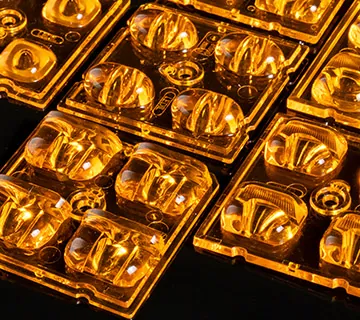
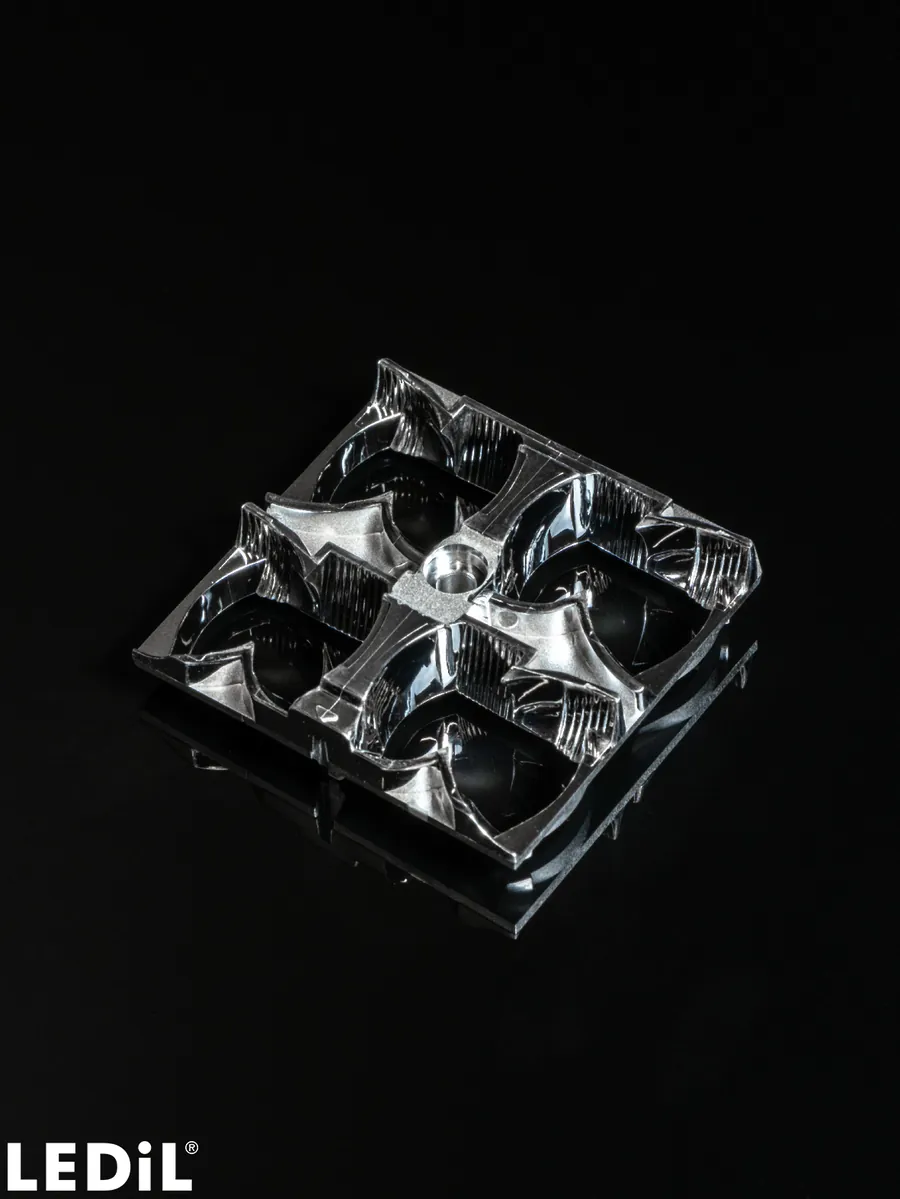
All lenses in VALDUR are based on LEDiL’s 2×2 platform (50×50 mm). You first select the light distribution (T2, DWC, T4…) and then the lens family based on requirements for light output and blue light reduction.
STRADA
Clear white lensRelative photopic flux, component example
Blue light reduction
Colour tone effect
Usually a small colour shift
Clear lens that transmits almost all light. Maximum light output. Used when high lux levels are required and blue light does not need to be filtered.
Suitable for: Traffic routes, industry, harbours, high light level requirements
Not suitable for: Nature areas, over-specified residential streets
AMBER
Yellow filterRelative photopic flux — example
Blue light reduction
Colour tone effect
3,000 K → ~2,200 K — noticeably warmer
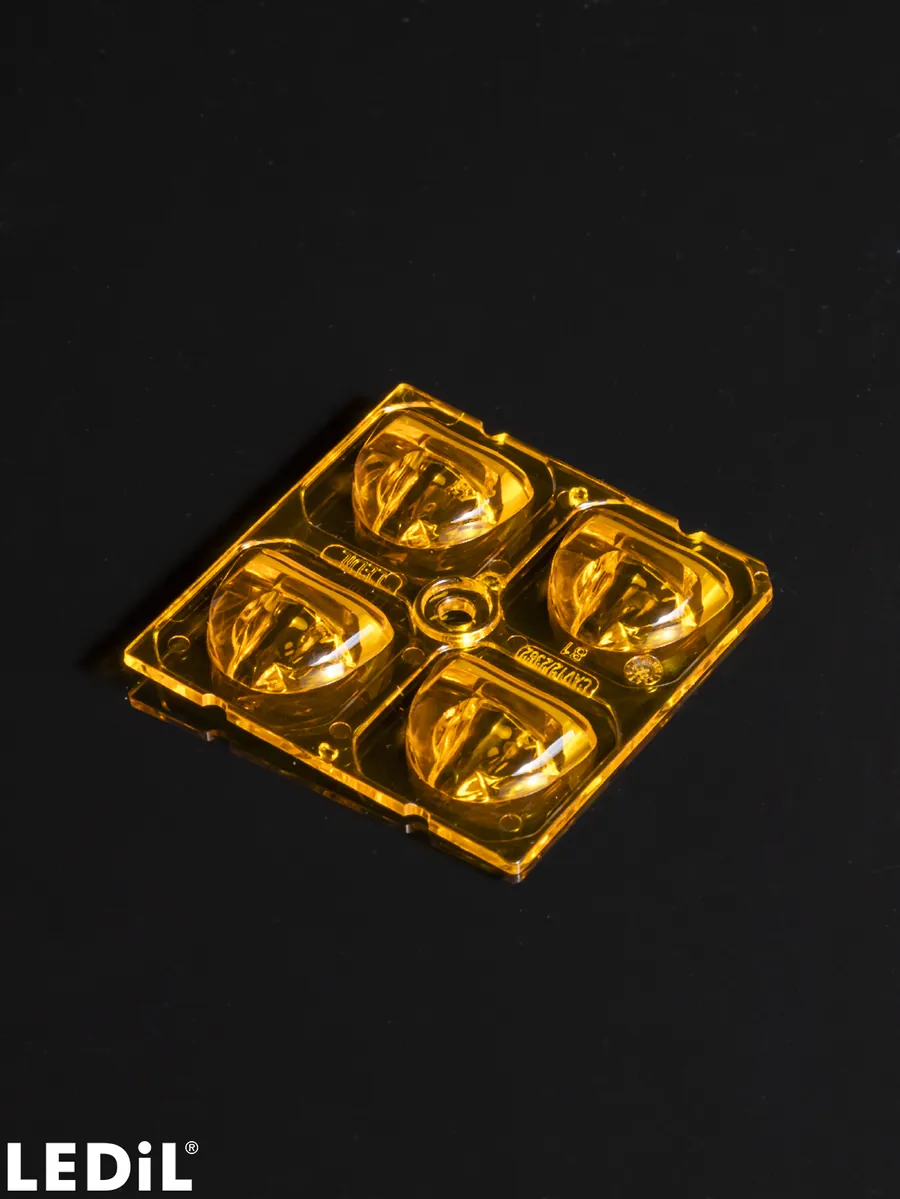
According to LEDiL manufacturer data, the yellow-tinted lens filters out approximately 99% of LED light within 380–500 nm; performance depends on the LED and optic. Colour rendering is affected: CRI drops from ~70 to roughly 35–55 (LEDiL). The VALDUR product table specifies 1900 K for Amber. The table below shows LEDiL component examples with Osram Duris S8. For VALDUR, the LED source colour temperature is specified separately for the selected LED module and optic. LEDiL AMBER The 70–84% luminous-flux range comes from LEDiL’s separate AMBER-2X2-T2 example with Luxeon 5050 Square across 2,200–6,500 K, relative to the same LED without a lens. It is not a general VALDUR value. LEDiL — T2 / Luxeon 5050 Square
| LED CCT | LED only | AMBER lens | Output |
|---|---|---|---|
| 2 200 K | 1 900 K | ||
| 2 700 K | 2 100 K | ||
| 3 000 K | 2 200 K | ||
| 4 000 K | 2 500 K | ||
| 5 000 K | 2 800 K | ||
| 5 700 K | 2 900 K | ||
| 6 500 K | 3 000 K |
LED source (left) compared with output through AMBER lens (right) — seven LED CCT options
Suitable for: Parks, residential areas, nature reserves, coastal environments
Not suitable for: Installations with high lux level requirements
Internal spectral filter
Visually similar to STRADA — the effect is measured in the spectrum, not visible to the naked eye
SPECTRE
Spectral conversionRelative photopic flux — example
Blue light reduction
Colour tone effect
3,000 K → ~2,200 K; 4,000 K → ~2,500 K
SPECTRE reshapes the spectrum and, according to LEDiL, reduces the blue component by approximately 99%. The manufacturer describes the technology as proprietary. Public product information does not substantiate a particular phosphor coating or exact material construction. LEDiL’s SPECTRE-Y-2X2 family includes T2, SCL, ME and T4. VALDUR's article key lists SCL, T2, ME and T4 as project preferences. POLAB assesses the selected combination for each project. The quotation specifies the article number, components and performance. CRI drops to roughly 30–45; UV endurance tested to the equivalent of >20 years of European exposure with ~6 % impact (LEDiL). LEDiL SPECTRE
These spectral examples are LEDiL component measurements with Luxeon 5050 Square and SPECTRE-Y-2X2-T2. VALDUR spectrum and output data are specified separately for the selected LED module and optic, together with the project article number. LEDiL SPECTRE. The stated CCT values do not necessarily follow the black-body locus. The 92–107% range applies to that T2 component example across 2,200–6,500 K. A value above 100% describes photopically weighted flux relative to the bare LED, not energy creation.
| LED CCT | LED only | SPECTRE-Y | Output |
|---|---|---|---|
| 2 200 K | 1 850 K | ||
| 3 000 K | 2 200 K | ||
| 4 000 K | 2 500 K | ||
| 5 000 K | 2 700 K | ||
| 6 500 K | 2 800 K |
LED source (left) compared with output through SPECTRE-Y lens (right) — five LED CCT options
Suitable for: Larger roads, squares, car parks where both high lux and low blue light are required
Not available: DWC variant does not exist in the SPECTRE family
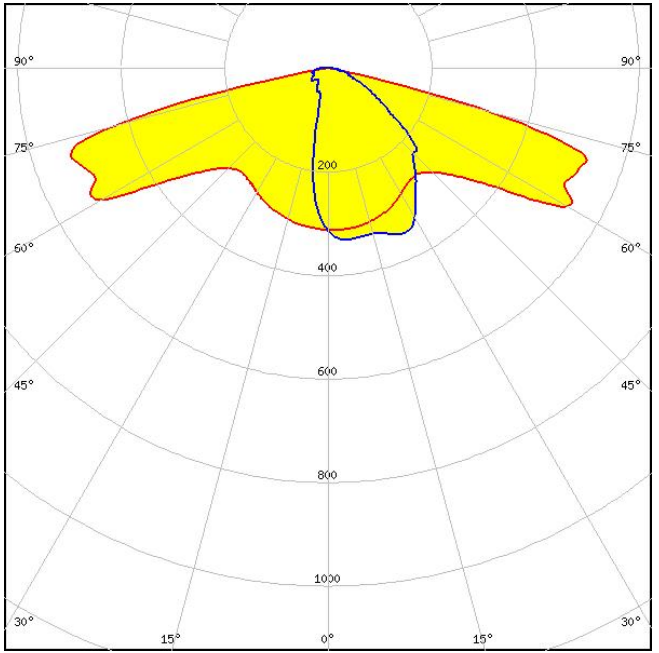
Light distribution curves from LEDiL
These polar diagrams show luminous intensity distribution for the specified 2×2 lens and LED. They are LEDiL component measurements, not photometry of a complete VALDUR luminaire. The scales differ between diagrams. Lighting design requires an IES or LDT file for the selected luminaire, LED, optic and drive current.
Component example
STRADA-2X2-DWC
LED: Philips Fortimo FastFlex LED 2x8 DA G4
Source: LEDiL datasheet, p. 18 ↗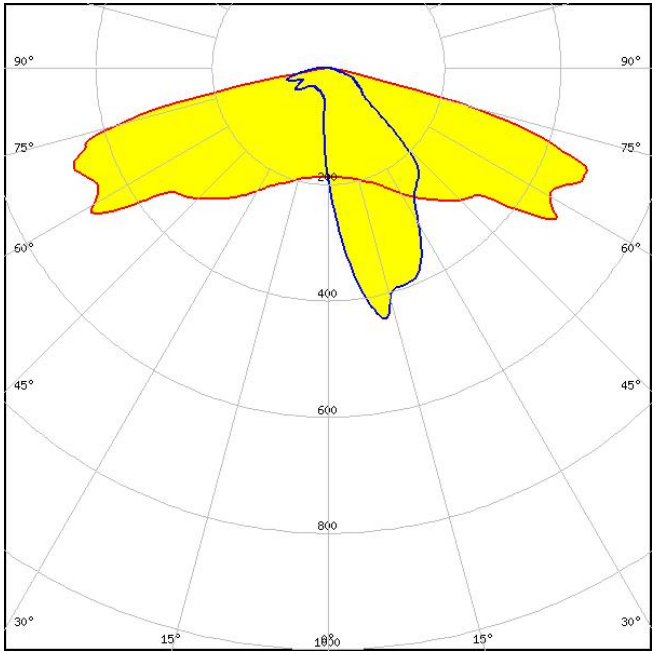
Component example
STRADA-2X2-T2
LED: Philips Fortimo FastFlex LED 2x8 DA G4
Source: LEDiL datasheet, p. 18 ↗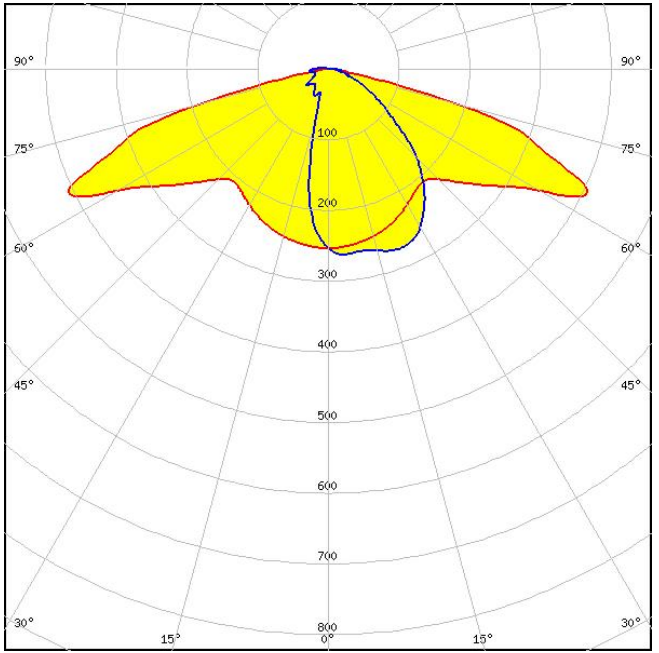
Component example
AMBER-2X2-DWC
LED: Philips Fortimo FastFlex LED 2x8 DA G4+
Source: LEDiL datasheet, p. 5 ↗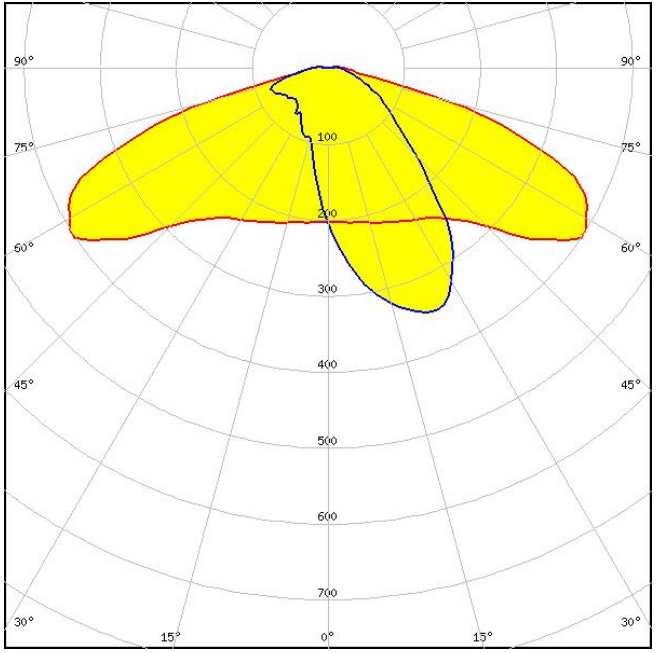
Component example
SPECTRE-Y-2X2-T2
LED: Lumileds LUXEON 5050 Square LES
Source: LEDiL datasheet, p. 3 ↗Compare optics
Data from LEDiL data sheets and the optics reference guide. The table shows all five light distributions with their properties and recommendations. LEDiL — beam guide
Optic names describe light distribution, not a lighting class. M classes address motor traffic, C classes conflict areas and P classes pedestrian and cycle traffic and certain low-speed areas. Select the class and applicable national requirements for the project. Verify compliance through a project-specific calculation with the correct IES or LDT file. EN 13201-2
| Optic / Beam | Best suited for | Light pattern | Strength | Limitation |
|---|---|---|---|---|
DWC Type III |
Local roads, residential streets, general urban lighting | Asymmetric, medium width, long reach | Distribution for local roads; verify flux and uniformity for the project. | Not narrow enough for tight footpaths. No SPECTRE variant. |
T2 Type II |
Footpaths, cycle paths, narrow roads, lit trails, boulevards | Narrow, elongated, long reach | Distribution for narrow routes; verify uniformity and glare for the project. | Calculate width coverage and luminous flux for the selected LED/lens combination. |
SCL Type II/III extra long |
Footpaths and local roads with long pole spacings | Very wide and elongated | Long distribution for large pole spacings. | Some geometries can produce non-uniformity at low mounting heights. Requires careful lighting design. |
ME With back light · available on request |
Wide roads with high uniformity requirements, area lighting | Medium width with back-light component | Can contribute to high uniformity (high Uo). Back light gives good coverage behind the column. Class compliance is verified for the complete installation. | Back-light component can cause spill light if luminaire is aimed incorrectly. Requires correct design. |
T4 Type IV |
Squares, car parks, wide open areas, tunnels | Extremely wide distribution | Maximum width coverage. Suitable where wide distribution is the primary requirement. | High risk of spill light beyond the carriageway. Glare and spill light must be checked in the lighting calculation. |
STRADA, AMBER and SPECTRE — what sets them apart?
| Lens family | Photopic flux / LED flux | Blue-light reduction | CCT shift |
|---|---|---|---|
| STRADA (clear) | Depends on LED and optic | No intentional filtering | Usually a small colour shift |
| AMBER (yellow) | 70–84 %* | ~99 % (380–500 nm) | 3,000 K → ~2,200 K |
| SPECTRE-Y | 92–107 %* | ~99 % (LEDiL) | 4,000 K → ~2,500 K |
LEDiL’s published SPECTRE-Y-2X2-T2 examples use Luxeon 5050 Square and show photopic luminous flux close to the bare LED’s level. The manufacturer states that performance depends on the LED, spectrum and distribution. This is not 100% radiometric transmission or a measured VALDUR value. AMBER reduces blue light and total photopic luminous flux. Component relative luminous flux is referenced to the same LED without a lens; it is not automatically the same percentage loss relative to a clear lens. The luminaire requires photometry for the selected LED, lens and drive-current combination. LEDiL SPECTRE LEDiL AMBER
Good to know
Light distribution
Where the light lands on the ground. A narrow distribution concentrates light along the road; a wide distribution spans a larger area.
Glare
When light strikes the eye instead of the surface. Excessive intensity in the field of vision reduces visibility. The risk is affected by the interaction between light intensity, optic, mounting height, luminaire aiming and the observer’s position.
Uniformity (Uo)
Uo is the ratio of the minimum to the average value of the quantity assessed, for example Lmin/Lm for an M class. A value close to 1 means high uniformity.
Spill light
Light that ends up where it does no useful work — onto building facades, into woodland, up towards the sky. Increases energy consumption and negatively affects environments and wildlife.
Column spacing
The spacing between columns affects which optic works. With long spacing, an optic with long reach, such as T2 or SCL, often needs to be evaluated in the lighting calculation. Shorter spacing gives more freedom.
Optical efficiency
Here photopic flux after the lens is compared with the same bare LED. This is neither lm/W nor radiometric transmission. Spectral change can produce a photopic ratio above 100% even though radiant energy is lost.
Request data for the selected LED module, optic and drive current. POLAB confirms which IES/LDT files are available and whether they use component data, calculation or measurement of the complete luminaire. The white-light values shown here are provisional calculations, not measured luminaire photometry.
North American classification of light distribution width (Type I–V). Type II = narrow, Type III = medium, Type IV = wide. Used in IES files and lighting calculation software.
CCT (colour temperature)
CCT is expressed in kelvin. The lens-induced colour shift depends on the LED spectrum: 3,000 K to about 2,200 K is a component example, not a constant 800 K reduction.
Isolux diagram
A map of light levels on a surface, where lines connect points of equal illuminance (lux). Used to assess coverage and uniformity in a project.
The luminaire can be adapted. It should be.
VALDUR is built for a long service life, but the right optic determines how well the light actually works in the project. A luminaire with the wrong lens may meet requirements on paper but deliver a poor experience in reality.
The combination of optics, colour temperature, controls and mounting height should be seen as a system. The right optic can reduce spill light, improve uniformity and make the installation more energy-efficient — without adjusting power output or the number of luminaires.
VALDUR’s LEDiL 2×2 platform may allow the lens to be changed. Compatibility, mounting, and thermal and photometric data must be verified for the specific configuration before any change.
The lens affects more than the light pattern
Colour temperature (AMBER/SPECTRE), blue light profile, glare risk and luminous efficacy are all affected by lens choice.
Five distributions, three lens families
DWC is standard. Other optic selections are handled as project configurations on request. Share the project requirements; POLAB specifies the article number and performance in the quotation.
Photometric data on request
Photometric files in IES and LDT format can be requested for each power and optic combination. Use DIALux or Relux for verification.
About optics & lens selection
Can I change the lens without replacing the luminaire?
VALDUR uses selected optics from LEDiL’s 2×2 platform (50×50 mm). A common footprint alone does not verify that a lens can be changed. POLAB must confirm compatibility between the lens, LED module and mounting, together with the thermal and photometric data for the specific configuration.
What happens to light output if I choose an AMBER lens?
AMBER reduces blue light and total photopic luminous flux. Component relative luminous flux is referenced to the same LED without a lens; it is not automatically the same percentage loss relative to a clear lens. The luminaire requires photometry for the selected LED, lens and drive-current combination. Use the complete luminaire’s IES/LDT file for the correct lens, LED source and drive current. A component percentage cannot establish average luminance, uniformity or glare. Recalculate the installation after changing the lens; no lens family automatically guarantees class compliance.
When should I NOT use the T4 lens?
T4 has a broad distribution and may spill light on narrow sites. Compare suitable distributions and check glare and light outside the target area in the installation calculation.
Is the SPECTRE lens available for all light distributions?
No. VALDUR's article key lists SCL, T2, ME and T4 as project preferences, but availability and performance must be assessed for the selected combination. For VALDUR, SPECTRE is handled as a project configuration on request. Specify the required distribution; POLAB assesses the combination and specifies the article number, components and performance in the quotation. If you need DWC distribution with reduced blue light, choose AMBER-2X2-DWC; verify the luminous flux of the selected combination.
How do I choose column height and column spacing?
All VALDUR lens families can be used at different mounting heights. Higher mounting normally gives a larger illuminated area but lower illuminance at ground level with the same luminous flux. Column spacing, road width, mounting angle, luminous flux and requirements for uniformity and glare determine which optic is most suitable. Verify the final choice with the current IES or LDT file in DIALux or Relux.
Related technologies
ALSO READ IN THE KNOWLEDGE BASE
DOCUMENTS & PRODUCT
Request the complete technical documentation.
Request data for the selected LED module, optic and drive current. POLAB confirms which IES/LDT files are available and whether they use component data, calculation or measurement of the complete luminaire. The white-light values shown here are provisional calculations, not measured luminaire photometry.
Sources
- LEDiL — Create biologically sustainable lighting with LEDiL AMBER lenses
- LEDiL — SPECTRE: Eliminate blue light, with efficiency you won’t believe
- LEDiL — SPECTRE
- LEDiL — Product catalogue 2019, street and area beam guide
- DarkSky / IES — Five Principles for Responsible Outdoor Lighting
- SIS — SS-EN 13201-2:2016 / EN 13201-2:2015, Road lighting — Performance requirements